
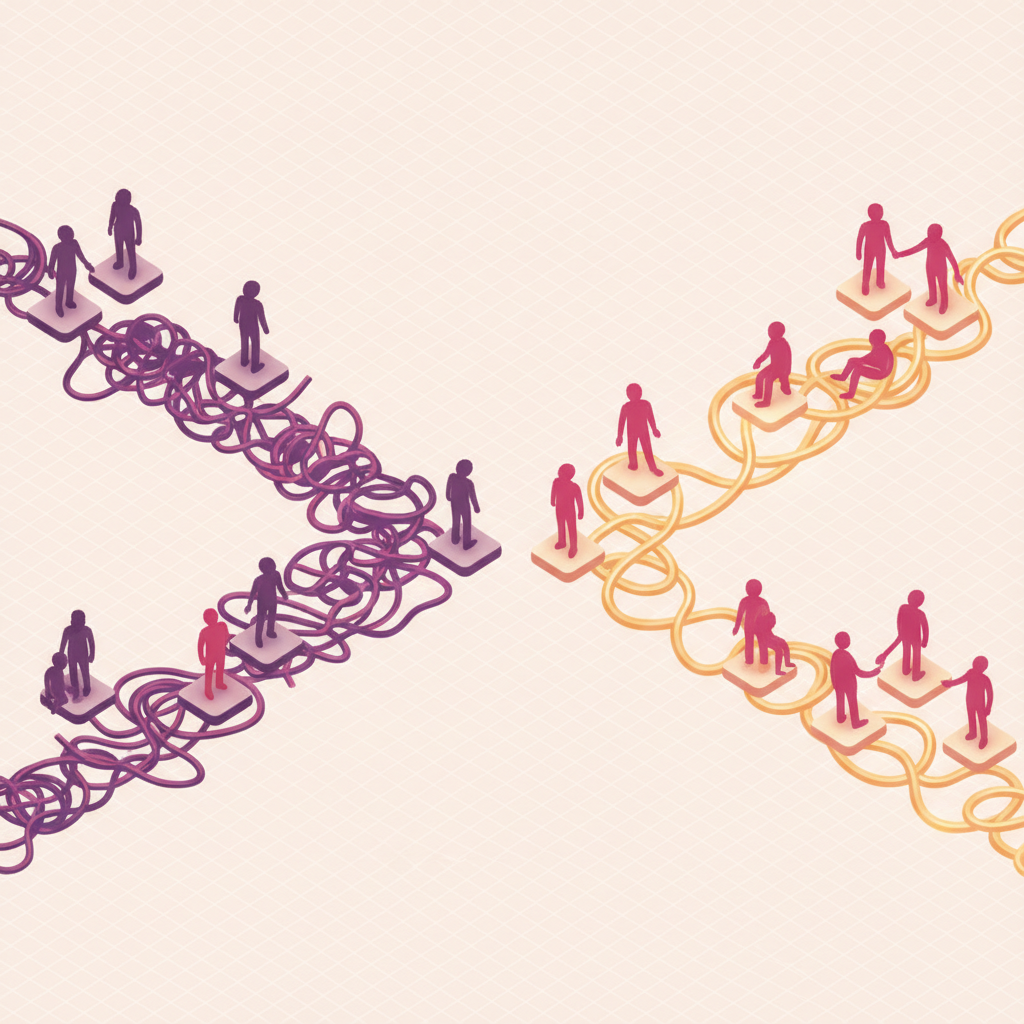
A pattern emerges across our recent client conversations spanning DACH and US markets. German companies consistently ask how AI can free up senior talent for strategic relationship work. American firms typically want to automate 80% of existing tasks.
These are fundamentally different starting questions. One builds stronger, more connected organizations. The other risks creating efficient but hollow operations.
The Right Work for AI
AI excels at reducing manual, repetitive, granular work — data entry, formatting, shuttling information between systems. Not strategic, creative, relational work. Relationship building is the work. AI should give us more time for human connection, not less.
When we see a sales team use AI to clear administrative hours and have more genuine conversations with more customers, that's the version of this technology that makes sense. When we see teams use AI to blast out more cold outbound faster, that's the version that will be obsolete in eighteen months.
The difference matters because the second approach treats AI as a relationship substitute rather than a relationship enabler. Mass automation often destroys the human touch that creates actual business value.
The Craft Problem
AI can do almost anything today. Learn any skill, execute any task. This capability creates an unexpected problem: work still needs to feel meaningful.
We connect with our work through the doing — the craft, the actual making. Success feels real when we've personally contributed to achieving it. Outsource everything to AI and we lose that connection to our output.
The solution isn't avoiding AI. It's developing craft in working with AI.
Clean communication with AI becomes a skill. Thinking through problems together with AI becomes an art. Working critically with AI outputs — questioning, refining, directing — becomes craftsmanship in itself.
Writing, designing, sketching, conceptualizing alongside AI while maintaining your distinct voice and judgment. This collaboration preserves the human element while capturing AI's processing power.
DACH vs US Approaches
The regional difference in AI implementation philosophy reflects deeper cultural values around work and human capital.
DACH companies typically frame AI questions as: "How can we give our senior people more time for the work only they can do?" This preserves human expertise while eliminating busywork.
US companies more often ask: "How can we automate 80% of this function?" This optimizes for efficiency but may gut the human relationships that drive long-term business success.
Neither approach is inherently right or wrong. But the DACH framing produces more robust, connected organizations over time. It treats human judgment and relationships as irreplaceable assets rather than costs to minimize.
Practical Implementation
At NxtConnect AI, we see this philosophy in action. Our platform handles zero-touch data entry, meeting preparation, and relationship scoring. But the actual conversations, strategic decisions, and relationship nurturing remain entirely human.
A partner at a consulting firm recently told us: "Your AI frees me from spending an hour after each client meeting updating records. Now I spend that hour thinking about what the client actually needs."
That's the pattern worth replicating. AI eliminates friction so humans can focus on value creation.
The best implementations we've seen follow three principles:
Preserve human craft: Identify which parts of the work people genuinely enjoy and derive meaning from. Protect those elements.
Eliminate administrative overhead: Use AI ruthlessly on data entry, scheduling, formatting, and system coordination. These tasks add no human value.
Amplify relationship capacity: Deploy the time savings toward deeper customer relationships, strategic thinking, and creative problem-solving.
The Long View
AI's power lies in serving relationships, not replacing them. Organizations that understand this distinction will build more resilient competitive advantages.
Find a craft you want to develop — even if AI assists in the process. That human element is what survives technological change. The companies that preserve and cultivate human expertise while leveraging AI for operational efficiency will outperform those that optimize purely for automation.
The question isn't whether to use AI. It's whether AI makes your organization more human or less human in its interactions with customers, partners, and itself.
Key Questions
Q: How do you know if AI implementation is working correctly?
A: Your team should have more time for strategic work and relationship building, not less. If people are becoming more isolated from customers or each other, the implementation needs adjustment.
Q: What's the difference between AI as a tool versus AI as a replacement?
A: AI as a tool eliminates busywork so humans can focus on high-value activities. AI as a replacement removes human judgment and relationship elements that often drive long-term business success.
Q: Should companies avoid automating customer-facing processes?
A: Automate the background work that supports customer interactions — data preparation, scheduling, follow-up reminders. Preserve human judgment in actual customer conversations and strategic decisions.
Q: How can organizations maintain craft and meaning in AI-assisted work?
A: Develop skills in directing AI, critically evaluating AI outputs, and maintaining your distinct voice in AI-assisted work. The collaboration itself becomes a form of professional craft.
Q: Why might the DACH approach to AI create stronger organizations?
A: It prioritizes human expertise and relationships as irreplaceable assets rather than costs to minimize. This typically produces more resilient competitive advantages and higher employee engagement over time.